
Milton of Buchanan
Milton of Buchanan is a small village approximately 2 miles (3 km) northwest of Drymen, to the northwest of Buchanan Castle. Historically, the village served as the principal settlement of the parish of Buchanan, which encompasses traditional Clan Buchanan lands along the eastern shores of Loch Lomond.
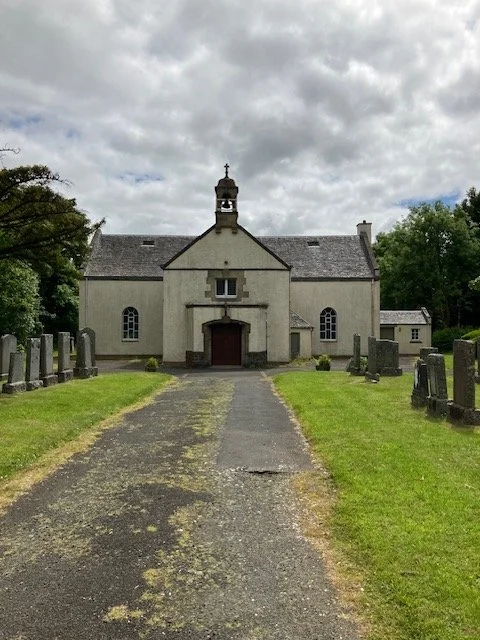
The village's development is closely tied to 18th-century estate architecture linked to the Buchanan Castle Estate. In 1761–1764, the Buchanan Parish Church – a T-plan structure with a projecting laird's aisle – was designed by prominent Scottish architect John Adam and constructed by mason Alexander Gowan on commission from the Duke of Montrose, replacing an earlier chapel near the Old House of Buchanan.
The church, which features round-arched openings and a moulded eaves cornice, underwent refurbishments in 1825 and after a 1938 fire, and its graveyard contains 18th- to 20th-century monuments, including those of the Graham family (Dukes of Montrose) and Clan Buchanan.
The name reflects its early functional role in the medieval landscape: "Milton" derives from Old English mylen-tūn, meaning "mill settlement" or "town by the mill," pointing to the presence of milling activities associated with local watercourses for processing grain. The suffix "of Buchanan" links it to the parish and the dominant Clan Buchanan.
During the medieval period, Milton of Buchanan emerged as part of a feudal estate under the Earls of Lennox, with significant land grants to the ancestors of Clan Buchanan in the 13th century.
Early settlement in the area involved the construction of farmsteads and steadings, influenced by the foundational development of the Buchanan estate in the 13th and 14th centuries, which supported agricultural tenancies and local jurisdiction under chiefs like Maurice Buchanan. These developments laid the groundwork for a dispersed rural community tied to the clan's feudal authority.
Milton of Buchanan serves as a key part of the historical heartland for Clan Buchanan, whose traditional lands along the eastern shores of Loch Lomond were granted in 1225 to the clan's progenitor, Sir Absalon, a clergyman from Lennox. This 13th-century endowment established the area, including Milton, as the clan's enduring territorial core, with the parish of Buchanan encompassing much of these holdings and reflecting the family's influence since medieval times.
The locality's environs have contributed to Scotland's romantic cultural imagery, appearing in 19th-century travelogues that extolled Loch Lomond's scenic beauty and inspired artistic depictions of Highland landscapes. Accounts from the period, such as those in local histories like Strathendrick, and its Inhabitants from Early Times (1896), reference Milton of Buchanan amid descriptions of the loch's idyllic settings, which influenced writers and painters envisioning the sublime Scottish countryside. This legacy aligns with broader literary works, including Walter Scott's evocations of nearby Trossachs scenery, embedding the region in narratives of natural grandeur and historical romance.
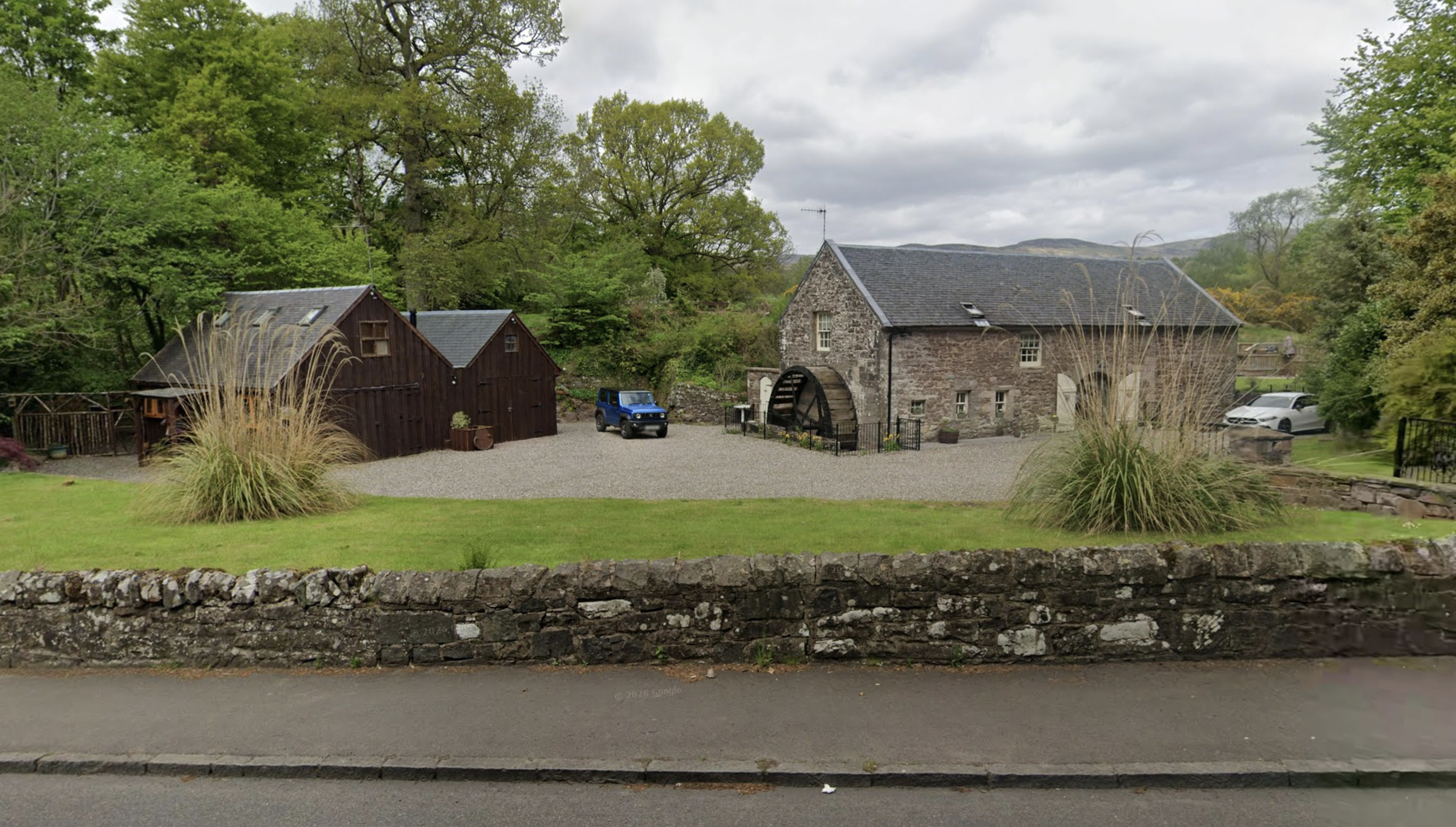
Old Mill (formerly Buchanan Mill)
In contemporary contexts, Milton of Buchanan features in conservation stories within Loch Lomond and The Trossachs National Park, designated in 2002 to safeguard its biodiversity, cultural sites, and scenic integrity against development pressures. Local folklore enhances this modern cultural fabric, with tales of hauntings circulating around the ruins of nearby Buchanan Castle, evoking the area's haunted heritage tied to its 19th-century baronial past and wartime use. Preservation initiatives underscore these efforts, notably through Historic Environment Scotland's Category C listing of the Old Mill (formerly Buchanan Mill) in 1973, which protected its late 18th- to early 19th-century corn-milling machinery and structure during a 1990s residential conversion, maintaining industrial artifacts like the iron wheel and internal gears.
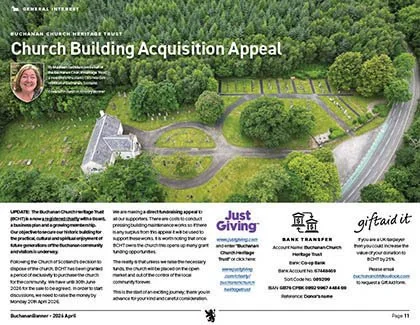
Buchanan Church Heritage Trust – Church Building Acquisition Appeal
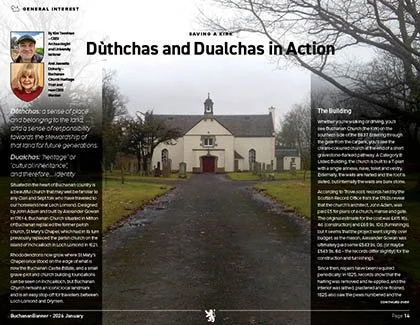
Over the last couple of years, the Buchanan community has mobilised to save one of its most treasured buildings – Buchanan Church. The Buchanan Church Heritage Trust (BCHT) is a registered charity with a Board, a business plan and a growing membership. Its objective is to secure our historic building for the practical, cultural and spiritual enjoyment of future generations of the Buchanan community and visitors.
The reality is that unless we raise the necessary funds, the church will be placed on the open market and out of the control of the local community forever. Details of how to make a donation:


Account Name: Buchanan Church Heritage Trust
Bank: Co-op Bank
Sortcode: 08-92-99
Account Number: 67448469
IBAN: GB76 CPBK 0892 9967 4484 69
READ MORE:
P.S. If you would like to know more, want to read our business plan, or can aid with tangible support, please contact:
Louise Doherty 07886 309 732,
Ronnie Graham 07708 161228 or
Rosie Allan 07899 807 601
Click to open PDF
Click to open PDF